Documentation
Design Matrix
The main.get_design() function can be used to retrieve the design matrix from an
index.
The index must correspond to one in the table of Chen et al. [1993] or
Xu [2009].
For both papers, the index is composed of three numbers representing:
the number of factors in the design (\(n\))
the number of added factors (\(p\), where \(n > p\))
the rank, in term of abberation, of the design
Word length pattern
In regular designs, aliasing is either full or null. Thus, added factors are made out of interaction between basic factors, this interaction is called a generator. If we represent basic factors by lower case letters, then an added factor can be represented by a string of all the letters corresponding to the basic factors used in its generator. For example, consider a design in 32 runs, there are five basic factors: \(a,b,c,d,e\). Consider an added factor \(f\) made of the interaction between factors \(a,b,c\). This means that the levels of factor \(f\) are made of the interactions between the levels of \(a,b,c\). Then we can write the string \(abcf\) to represent that relation. This string is called a word and has a length of four since it has four letters. Multiplying words together generates other words. For example multiplying \(abcf\) with \(acde\) yields the word \(bdef\). Thus, a design with \(p\) added factors has a set of \(2^{p}-1\) words in total.
For a \(2^{n-p}\) design \(D\), let \(A_{i}\) denote the number of words of length \(i\) in the set of all words. The vector
is called the word length pattern of the design \(D\). The resolution of a design is the length of the shortest word in the set of all words.
The function main.get_wlp() allows you to retrieve the word length pattern of a design from the catalog.
Depending on the resolution \(R\), the first number in the word length pattern is \(A_{R}\).
For more informations about the word length pattern, see the paper of [Wu and Xu, 2001].
Clear two-factor interactions
A two-factor interaction, denoted a TFI, is an interaction between two two-level factors. It can be aliased with another factor (in a word of length 3) or with another two-factor interaction (in a word of length 4). If a TFI is not aliased with any factor or any other TFI, then it is said to be clear. A clear TFI is interesting because it allows the estimation of the interaction without the aliasing effect of other interactions that could be active.
The function main.get_cfi() allows you to retrieve the number of clear two-factor interactions of a design from the catalog.
Clear interactions graph
Apart from the number of clear two-factor interactions, it can also be useful to visualize which interactions are clear. For this purpose, Grömping [2012] introduced the clear interaction graph (CIG). In such a graph, all factors are represented by nodes and if a two-factor interaction is clear, then an edge is drawn between the two nodes of the interactions. For example, the 32-run design “8-3.4” has eight factors and 7 clear two-factor interactions that are shown on the graph below.
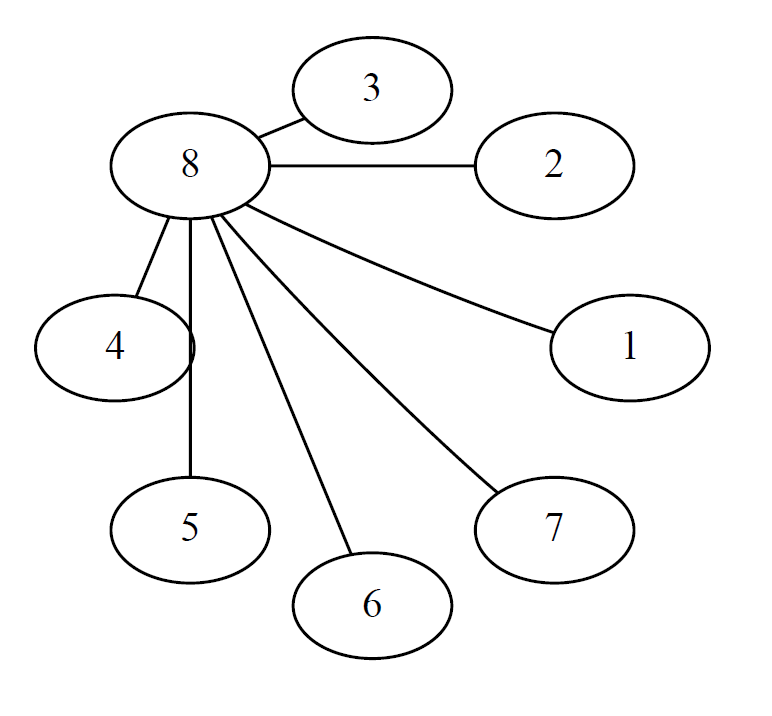
On the graph we see clearly that all clear two-factor interactions involve factor 8. So one experimental variable is suspected to have high interaction effect with the others, it might be interesting to assign it to factor 8 in the experimental design.
For the moment, there is no function available to generate such a graph for the designs of the two catalogs.
Bibliography
Jiahua Chen, D.X. Sun, and C.F.J. Wu. A catalogue of two-level and three-level fractional factorial designs with small runs. International Statistical Review, 61(1):131–145, 1993.
Hongquan Xu. Algorithmic construction of efficient fractional factorial designs with large run sizes. Technometrics, 51(3):262–277, 2009.
C.F.J. Wu and Hongquan Xu. Generalized minimum aberration for asymmetrical fractional factorial designs. The Annals of Statistics, 29(2):549–560, 2001.
Ulrike Grömping. Creating clear designs: a graph-based algorithm and a catalog of clear compromise plans. IIE Transactions, 44(11):988–1001, 2012.